Beyond Competition: Finding Strength in Connection
It’s funny what you learn sitting in a room full of eight and nine year olds all day. You start to think you understand things, see patterns. For a while the...

It’s funny what you learn sitting in a room full of eight and nine year olds all day. You start to think you understand things, see patterns. For a while there, I was convinced that *everything* was about getting ahead, proving yourself, being the loudest voice at the table. It felt like the whole world ran on competition. Spelling bees turned into standoffs, recess became a carefully orchestrated series of maneuvers for swing set dominance. You wouldn't believe how seriously those kids took their positions.
And then you read something that makes you rethink it all. I stumbled across this article—well, “stumbled” is putting it nicely; Mrs. Klein in the staff room practically shoved it at me—about these researchers looking at slime molds and ants and beetles. Apparently, they’re finding that creatures who aren't exactly known for their deep thinking can still work together pretty darn well. It wasn’t about some fancy agreement or a leader telling everyone what to do. Just...a tendency to help each other out.
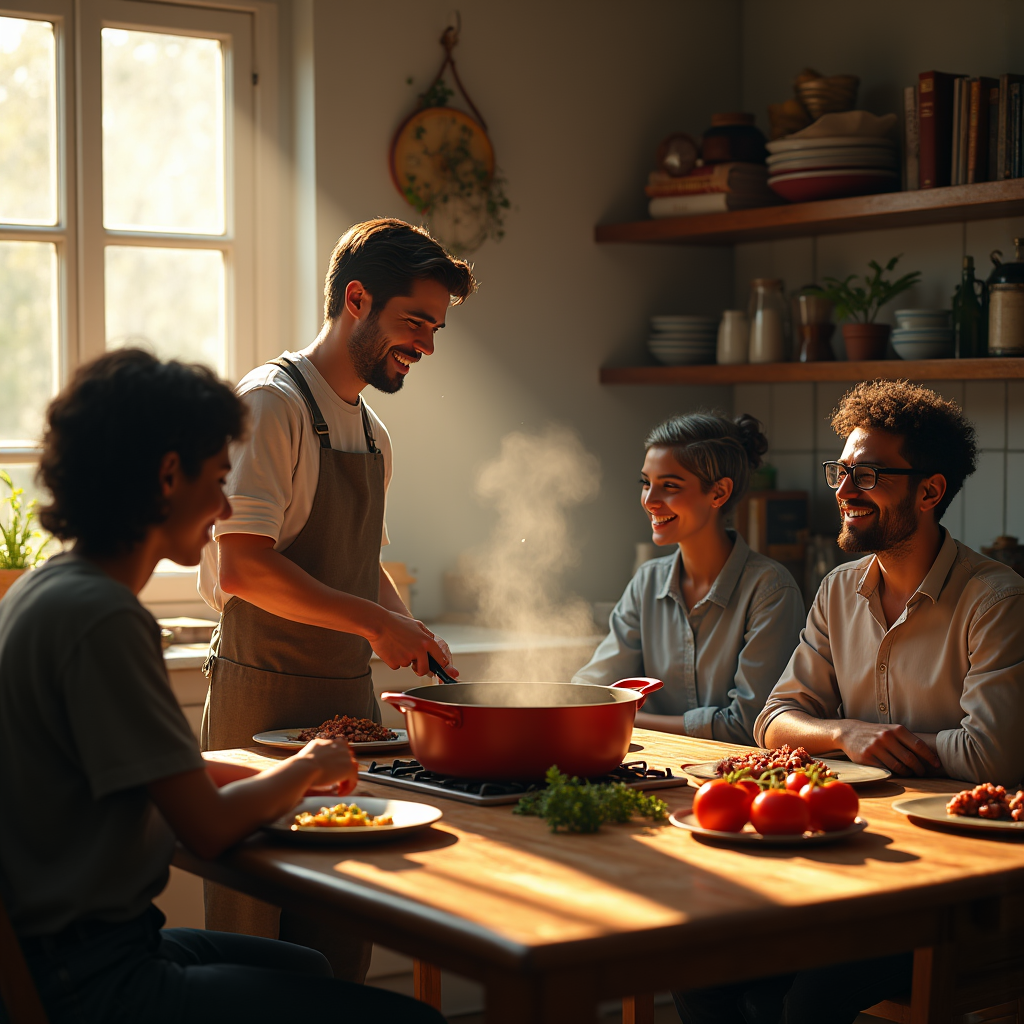
I’ve been wrestling with Sunday gravy all summer. My grandmother started teaching me years ago, but it always felt beyond my grasp – the right simmer time, the balance of herbs and tomatoes, the way the meat should practically melt into itself. It's a tricky thing to nail down; requires a patience I often don't have. But something about focusing on that process—slowly building the flavor, letting things develop over hours—it felt…cooperative. Like all these disparate ingredients were coming together for something greater than themselves.
It makes you wonder about how we frame evolution. For so long, we’ve been told it's this brutal free-for-all, a constant struggle for survival where only the fittest win. And sure, there *is* that. There always will be. But what if cooperation isn’t some kind of evolutionary afterthought, something that develops after everyone else has fought tooth and nail? What if it's woven into the fabric from the very beginning? Like a little secret ingredient in everything living.
There's this idea I remember from somewhere—some game theory thing about prisoners and choices—that’s supposed to show how selfishness always wins out. Seems kind of bleak when you think about it, especially after dealing with playground politics all year. But these researchers are showing that even in those scenarios, folks tend to find a way to work together. They do things that benefit the whole group, not just themselves. It's... optimistic. I needed some optimism this summer.
I spent a lot of time in Fishtown, this summer. Just sitting at the kitchen table, simmering things, thinking. Away from the fluorescent lights and the organized chaos of room 214. It was good to have that quiet. And it made me remember how much I like people – my family mostly, but all kinds. People who are willing to share their gravy recipe, or lend a hand without being asked. That's not selfishness; that’s something else entirely.
It has implications for things beyond biology too. Think about building robots, designing AI. We’re so focused on making them smarter, faster, more powerful. But what if the most important thing isn't intelligence? What if it's the ability to connect, to coordinate, to work with others – even when those "others" aren’t exactly like you? Maybe then we won't end up with machines that see humans as obstacles in their path.
It reminds me of something I tell my students: “Sometimes, being a good listener is more important than being right.” And they almost never get it right away, but eventually, some of them do. They figure out that there’s strength in compromise, in helping each other learn. Maybe that’s all it takes—a willingness to look beyond our own little corners and see how we fit into the bigger picture. Turns out, even slime molds understand that. And maybe, just maybe, so do we.