Decoding the Brain: Music, Tech, and Feeling
Yo, it's wild to think about where we're heading, honestly. I was bouncing ideas with my boy DeAndre last night – he’s in bio, always stressing over the late...

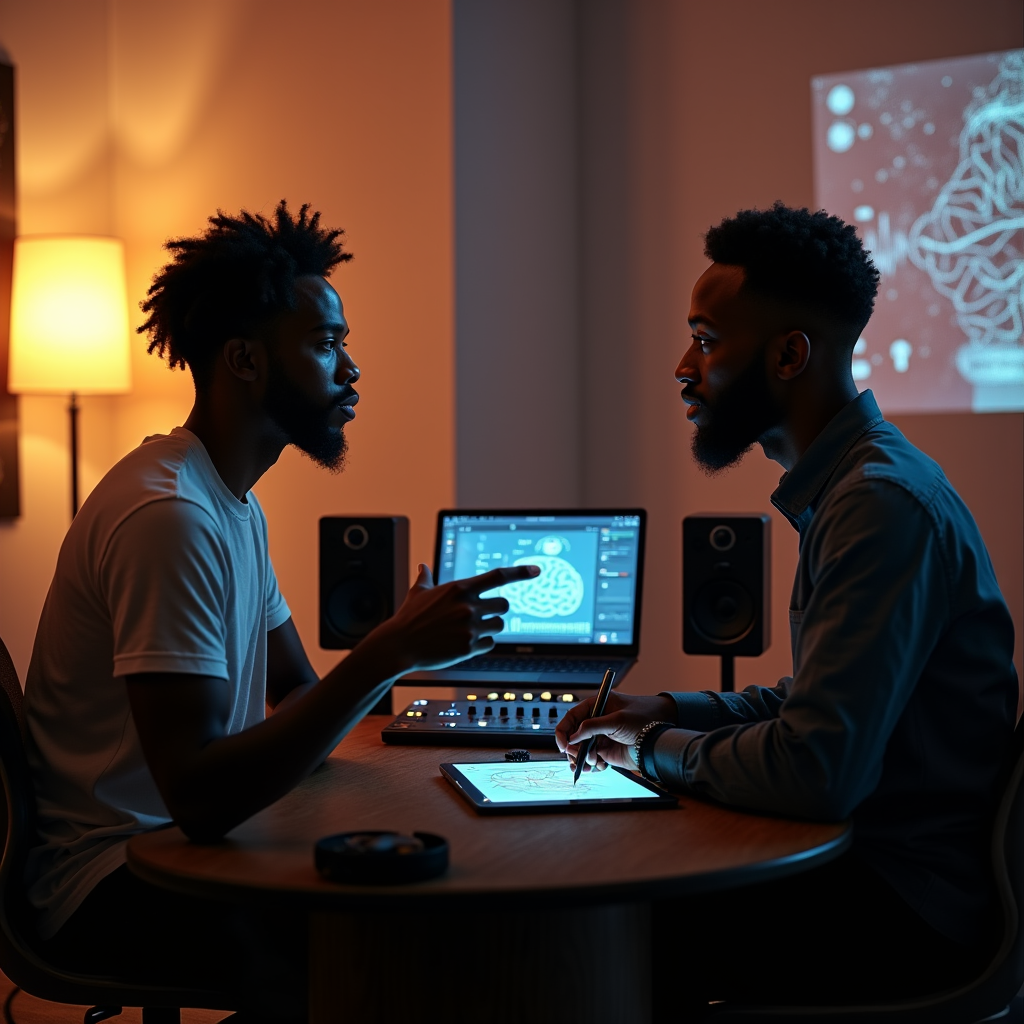
Yo, it's wild to think about where we're heading, honestly. I was bouncing ideas with my boy DeAndre last night – he’s in bio, always stressing over the latest cellular pathways – and he dropped this information about tracking brain chemistry in real-time. Not just like a vague scan, but actually seeing what’s happening with dopamine, serotonin, all that stuff. It’s less science fiction and more, "Okay, so when do we get the upgrade?"
I’ve been in a weird space lately, you know? Balancing Clark Atlanta, the studio, trying to make something out of this fit game. It’s a constant hum of pressure. Sometimes I feel disconnected, like I'm watching myself from a distance. I'm making beats, trying to find the pocket, the groove, that hits different. But the feeling isn't always there. Thinking about this new tech, this window into the brain, it makes you wonder what's behind those feelings. Is it just noise? Or is it something tangible?
Imagine being able to see exactly what’s happening when someone’s dealing with depression, anxiety, even just that low-key frustration that comes with trying to navigate life in Atlanta. It’s a different level of understanding. We're throwing around terms like "personalized medicine," but this feels like going deeper than that. It’s like, instead of treating symptoms, you’re addressing the root cause, the actual chemical imbalance.
The technical side of things is the mind-blower. I'm no scientist, but DeAndre was explaining it - something about combining voltammetry, which measures electrical potential, with machine learning. Basically, the brain is generating these complex signals, a chaotic mess of data. And now they’re teaching computers to decipher that mess, to pull out the patterns, the nuances. It’s like teaching a computer to feel.
He was talking about signal processing, algorithms, all this jargon that went over my head at first. But then it clicked. It’s similar to what I do when I’m making beats. You’ve got a raw sample, a collection of sounds. Then you manipulate it, chop it up, layer it, until you find something that resonates. It’s about isolating the elements that matter, the things that create the vibe. Same principle, different medium.
The challenges, though, are real. DeAndre mentioned how the signals can be faint, noisy, easily distorted. It’s not just about collecting data; it’s about cleaning it, filtering it, making sense of it. And that requires some serious processing power and some seriously smart algorithms. It's that same feeling I get when I’m working on a beat, tweaking the EQ, trying to get the bass to hit just right. It’s a process of refinement, of pushing the boundaries of what’s possible.
I'm thinking about the possibilities for music, too. Imagine a system that could analyze your brainwaves while you’re listening to a song, pinpointing exactly what’s triggering those feelings of joy, sadness, or nostalgia. Could we design music that’s specifically tailored to elicit those emotions? It's a little creepy when you say it out loud, but also... fascinating. Maybe that’s the next evolution of sound.
It’s a long way off, but the potential is undeniable. The beat I finished up in August, the one that felt...right, that unlocked something in my head – I wonder if, in a few years, we'll be able to see exactly what was happening in my brain at that moment. It's a little unsettling, but also hopeful. Maybe understanding the chemistry behind the creation can help us all create a little better. Maybe we can finally find the signal in the noise.