
The Artist's Secret: Following the Gaze
Imagine standing before a Vermeer, that *Girl with a Pearl Earring*, and wondering what she’s looking at. It’s a question I’ve asked myself countless times, ...

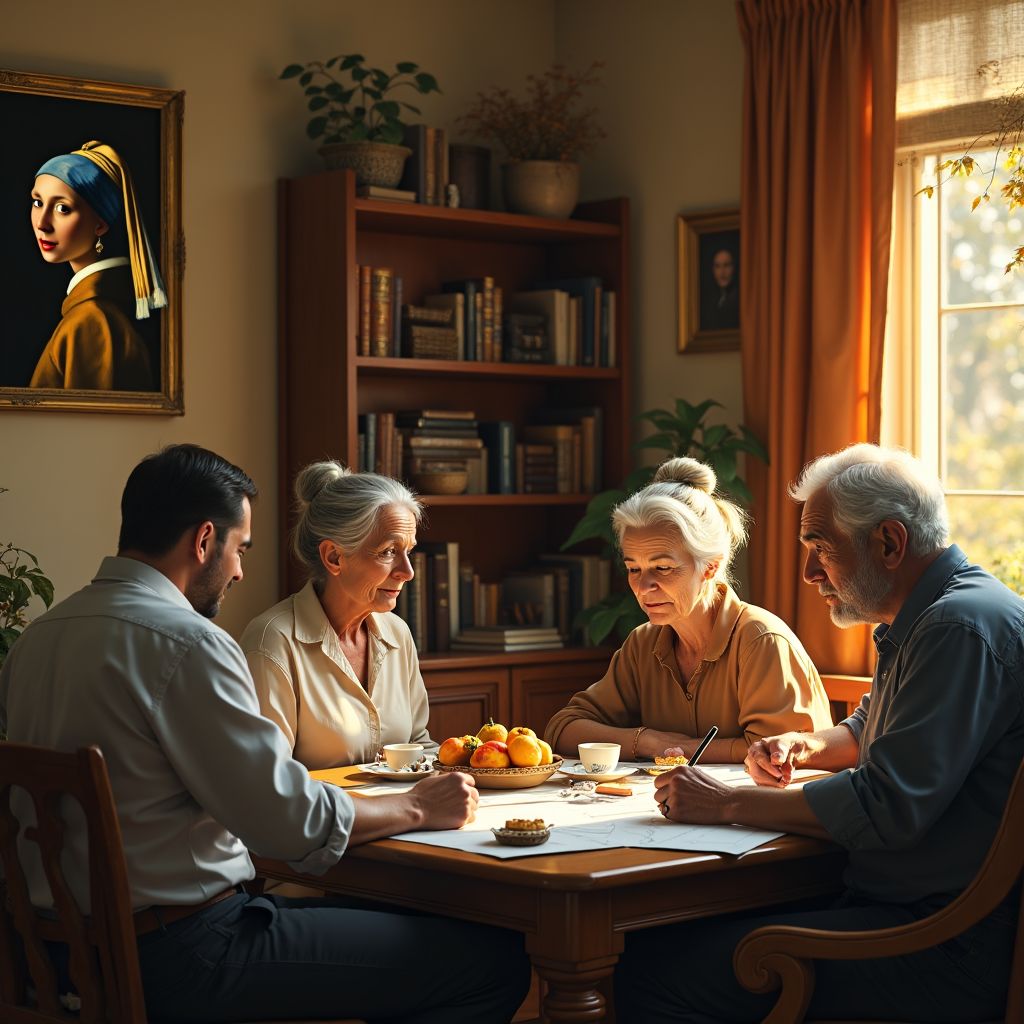
Imagine standing before a Vermeer, that *Girl with a Pearl Earring*, and wondering what she’s looking at. It’s a question I’ve asked myself countless times, especially since settling into this quiet retirement where time stretches out like newly planted rows of lavender. For decades, I saw it as simply…a portrait. Beautiful, certainly. A young woman, turned towards us, an expression both enigmatic and inviting. But recently, something shifted.
It began with Phyllis’s little backyard gatherings for the autumn equinox – just she and I, sharing tea and honey cakes under the persimmon tree. We started looking at things differently; not just at the stars, but at patterns in the leaves falling around us. It's a subtle thing, you see, how intention changes what you perceive. And it’s precisely that shift which has illuminated something quite extraordinary about early modern painting.
There’s been this fascinating study—I won’t bore you with details of its mechanics—but the core finding is remarkably simple: artists were *guiding* our gaze. Not in a heavy-handed way, mind you, but through these tiny, almost imperceptible gestures, the pointing fingers of figures within the painting itself. They weren't simply posing; they were directing us to something specific within the composition—an object, another figure, an unspoken narrative thread.
Think about those didactic paintings – the ones meant to teach a moral lesson. We’ve always recognized their purpose: to instruct, to exemplify virtue and vice. But we perhaps underestimated *how* they achieved that effect. Those figures who seem to be casually gesturing towards something in the scene? It wasn't chance. They were carefully positioned—and sometimes I imagine them rehearsed, just so—to draw your eye exactly where the artist wanted it to go.
I remember one student years ago – dear Thomas – who was stubbornly convinced that artists simply *responded* to their environment. "It’s all observation," he'd insisted, brandishing a charcoal sketch of a particularly grumpy-looking pigeon. And while that's certainly true, it doesn’t account for the deliberate crafting I’m now recognizing in so many familiar works. It wasn’t just about what they saw; it was about how they wanted *us* to see it.
I recall sitting with Bernard one afternoon, looking over reproductions of Renaissance paintings—he was trying to explain a particularly complex passage of Venetian architecture. He would always be precise and exacting, a necessary contrast to my sometimes meandering way of thinking. But even he, I suspect, hadn’t fully considered the implications of this research. It's like discovering a secret language woven into the fabric of the canvas, a silent conversation between artist and viewer across centuries.
It makes one reconsider everything. Those admonitor figures – the ones who seem to be scolding or advising—they aren’t simply there for visual balance. They are active participants in the unfolding story, nudging us towards a particular interpretation. It's astonishing really, how these subtle cues have been operating beneath our awareness all along. Imagine how much more deliberately artists worked!
Now when I look at a painting, I don’t just see beauty or skill. I see intention. A deliberate choreography of the gaze. And it makes those familiar images feel brand new again—as if they're revealing themselves to me for the very first time. Next time you visit an art museum, take a moment. Really *look*. Follow the fingers. See where they lead. You might be surprised at what you discover.