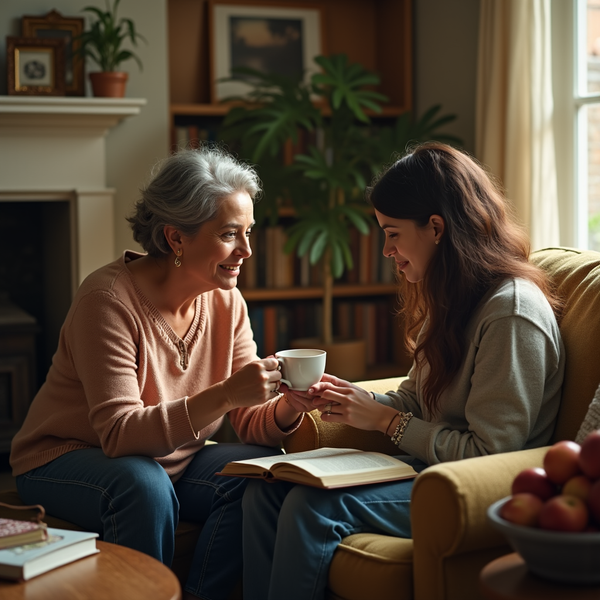
The Weight of Quiet Years
The quiet, you see, is a deceptive thing. It settles in around you, a comfort at first, and then a weight. It was the quiet of the house, mostly, after the c...


The quiet, you see, is a deceptive thing. It settles in around you, a comfort at first, and then a weight. It was the quiet of the house, mostly, after the children had flown and Bernard was at work, that made it so apparent. The quiet wasn't peaceful; it was the space left by a relentless churn. I’d spent years keeping that churn going – school, then the children’s various activities, then Bernard’s demanding career. Now, I was supposed to simply *be*.
It wasn’t just the house, though. It was the persistent, low hum of worry that had taken root in my bones. It started, I suppose, not suddenly, but gradually, with my mother’s failing health. Then, just as I’d begun to sort of manage that, my own sister, Margaret, started needing more. It's a pattern, really. Women, especially, are often the anchors in a family, the ones who carry the weight. We're taught to. I remember my own mother, always smoothing things over, always the one who stayed.
There's a particular exhaustion that comes with tending to two generations, an exhaustion that settles deeper than anything physical. It’s a weariness of spirit, a slow leaching of joy. It’s looking at Margaret, seeing fragments of my own mother reflected in her face – the same stoicism, the same insistence on “being strong,” the same way of minimizing her own needs. And then, I look at my own children, and I wonder if I’ve inadvertently passed on some of that same burden.
My daughter, Sarah, she’s always been particularly attuned to the undercurrents in a room. She noticed, even as a little girl, when I was holding back, when I was trying to be “brave.” She’d say, “Mommy, are you sad?” And I’d tell her, of course not, I was fine. But the truth is, I learned very early on to suppress those feelings, to prioritize everyone else’s needs. It was…expected. A virtue, even.
The pandemic, of course, made all of it so much worse. Suddenly, everyone was vulnerable, everyone was scared. The margins disappeared. Trying to coordinate Margaret’s care while also ensuring Sarah and her family were safe – it felt like a constant scramble. Bernard, bless his heart, tried to help, but he couldn't quite grasp the depth of the emotional labor involved. He saw the tasks, the appointments, the medication schedules. He didn't see the constant negotiation, the endless reassurance, the silent monitoring of unspoken anxieties.
And the guilt. There's always the guilt. Am I doing enough? Am I doing too much? Am I neglecting Bernard? Am I neglecting myself? It's a vicious cycle. You pour and pour until there's nothing left, and then you wonder why you feel so empty. I’ve started, just this past summer, to sit quietly in the garden, even when there are weeds to pull or seedlings to tend. Simply *being* present, without striving.
Phyllis, my neighbor, she understands. She lost her mother a few years ago, and she speaks of that quiet grief, that lingering sense of responsibility. It’s a comfort to talk to her, to acknowledge the weight without feeling the need to fix it. We’ve started having a small gathering on the equinox now. Just the two of us, sharing a simple meal and the solace of shared experience. It's a tiny thing, perhaps, but it's something.
It's not a quick fix, none of this. There isn’t a magic solution to the deeply ingrained ways we’ve been conditioned to care, to sacrifice. But maybe, just maybe, if we start to acknowledge the burden, if we start to create space for ourselves, if we start to speak honestly about the exhaustion, we can begin to shift the balance. Maybe then the quiet won't feel so deceptive, so heavy. Maybe then we can find a little bit of peace, a little bit of joy, in the midst of it all.